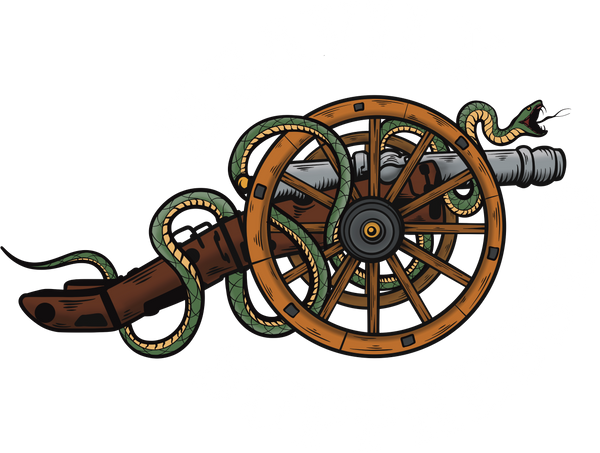
What Is Fiddler's Green? The Legend Behind the Gun Line's Drinking Club
Share
If you've spent any time around a gun line, you've heard somebody raise a glass "to Fiddler's Green." Maybe at a battery function, maybe at a memorial, maybe just on a Friday. It sounds like something ancient, and in a way it is. But the road from a sailor's superstition to a field artillery tradition is a longer and stranger one than most people realize.
It Started With Sailors, Not Soldiers
Fiddler's Green first shows up in nineteenth-century English maritime folklore as a kind of afterlife for sailors, specifically those who had put in something like fifty years at sea. The earliest accounts weren't especially flattering. An 1811 novel, The Sea-Devil, describes it as a "half-way house" where the Devil himself mixes the grog. A magazine writer in 1825 had unmarried men and women forced to dance together forever as a penalty for being poor company in life. Later writers, including Frederick Marryat in 1837 and George Whyte-Melville in 1866, warmed it up considerably: plenty of drink, music, and dancing, and none of the brimstone.
How the Cavalry Claimed It
The soldier's version is best known through a short poem called "Fiddlers' Green," sometimes titled the Cavalrymen's Poem. It appeared in the U.S. Army's Cavalry Journal in April 1923 under the initials "JHS," and nobody has pinned down a fuller name since. It became closely tied to the 1st Cavalry Division and is the regimental poem of the 2nd Cavalry Regiment. The idea is simple and easy to love: halfway down the trail to hell there's a shady meadow where troopers who've paid their dues rest, drink, and wait for the rest of the outfit to catch up.
How It Became an Artillery Thing
The U.S. Field Artillery Association tells the story as a legend rather than documented history, set in southwestern Oklahoma near the Wichita Mountains just after the Civil War, and it is candid that there are many versions. In the artillery telling, the field artilleryman has his own turn-off on the road to heaven and ends up in a valley camp of his own. Nobody can say exactly when the guns adopted it, and that's part of the charm. Folklore doesn't keep a unit history.
What we can say is that the name followed American troops around. A Navy enlisted club in Sasebo, Japan was called Fiddler's Green from 1952 to 1976. A fire support base in Military Region III, Vietnam carried the name in 1972, occupied mostly by elements of the 2nd Squadron, 11th Armored Cavalry. Marines later operated a Firebase Fiddler's Green in Helmand Province, Afghanistan. Bars and clubs on installations everywhere have borrowed it too.
Why It Stuck on the Gun Line
Artillerymen spend a lot of time doing hard, unglamorous work for results other people get credit for. A place where the crew gets a cold drink and a seat at the end of it is an easy sell. It also carries a quiet weight: when a battery toasts Fiddler's Green, they're usually thinking of someone who isn't at the table anymore. That's why the toast shows up at memorials as readily as at a hail and farewell.
Carrying It Around
We built the Fiddler's Green Drinking Club designs around that spirit, claiming the legend for the gun line. If you want something for the shelf or the cooler, the Fiddler's Green tumbler is the obvious pick, and the sticker is the cheapest way to mark a Pelican case or a toolbox. For wearing it, the Drinking Club tee does the job.
If the legend is your speed, the rest of the Death Card series carries the same dry, respectful take on life around the guns, one design for every role on the line.
Made it to the bottom? That's redleg discipline. Take 10% off for reading the whole fire mission — use code FIREMISSION10 at checkout (one use per customer). Shop everything →