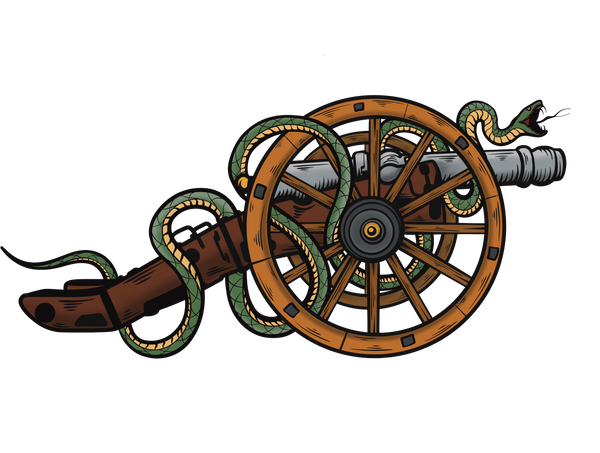
A Short History of the Noble Train of Artillery
Share
In the fall of 1775, the Continental Army had George Washington's forces surrounding British-occupied Boston — and almost nothing to force the issue. The siege had stalled. What the Continentals lacked was heavy artillery, and the nearest heavy artillery worth taking belonged to the British, sitting captured at Fort Ticonderoga, roughly 300 miles away in upstate New York.
Washington handed the problem to a 25-year-old former Boston bookseller named Henry Knox, who had no formal military engineering training but had read enough about artillery to talk his way into the job. On November 16, 1775, Washington ordered Knox to retrieve the guns. Knox left Cambridge days later and reached Ticonderoga by December 5th.
What followed is one of the great logistics stories of the Revolutionary War. Knox and his men moved nearly 60 tons of cannon and other armaments — dozens of guns, ranging from small mortars to massive siege pieces — across roughly 300 miles of terrain that offered no good options. They used boats where the rivers cooperated, ox-drawn sledges where they didn't, and raw manpower everywhere else. They crossed the Hudson River multiple times on ice that wasn't reliably frozen, hauled guns over the Berkshire mountain passes in the dead of winter, and fought through snow that in places was neck-deep.
The expedition took from mid-November 1775 to late January 1776. When the guns finally arrived outside Boston, Washington's forces used them to fortify Dorchester Heights overlooking the city and harbor — a position that put the British fleet and garrison within range of Continental artillery for the first time. Facing an untenable position, the British evacuated Boston in March 1776 without a fight.
No single Revolutionary War battle turned on the noble train of artillery. But the mission is still held up as a model of what artillery has always demanded beyond gunnery skill: the willingness to move impossibly heavy things through impossible terrain because the mission requires it. Two hundred and fifty years later, that's still the job — ask any redleg who's ever manhandled a gun into position.
Made it to the bottom? That's redleg discipline. Take 10% off for reading the whole fire mission — use code FIREMISSION10 at checkout (one use per customer). Shop everything →